
French Drains for Flood Prevention | Accurate Lawn Leveling
How Can French Drains Help Prevent House Flooding in Dallas, Houston, and Oklahoma?
French drains can help prevent house flooding by collecting excess groundwater and surface runoff before it reaches a home’s foundation, then redirecting that water to a safer drainage point. For homes in Dallas, Houston, and Oklahoma, a properly designed French drain can reduce standing water, saturated soil, foundation moisture, and the risk of water entering low areas around the house.
Accurate Lawn Leveling helps homeowners solve drainage problems before they turn into expensive water damage. Effective drainage is not simply about installing a pipe in the ground. The location, slope, soil conditions, runoff patterns, and discharge point all affect how well a French drain performs. By evaluating the entire property, Accurate Lawn Leveling can develop drainage solutions designed around how water actually moves through the yard. This approach is especially important across North Texas, the Houston area, and Oklahoma, where intense thunderstorms can overwhelm low spots and poorly draining areas quickly.
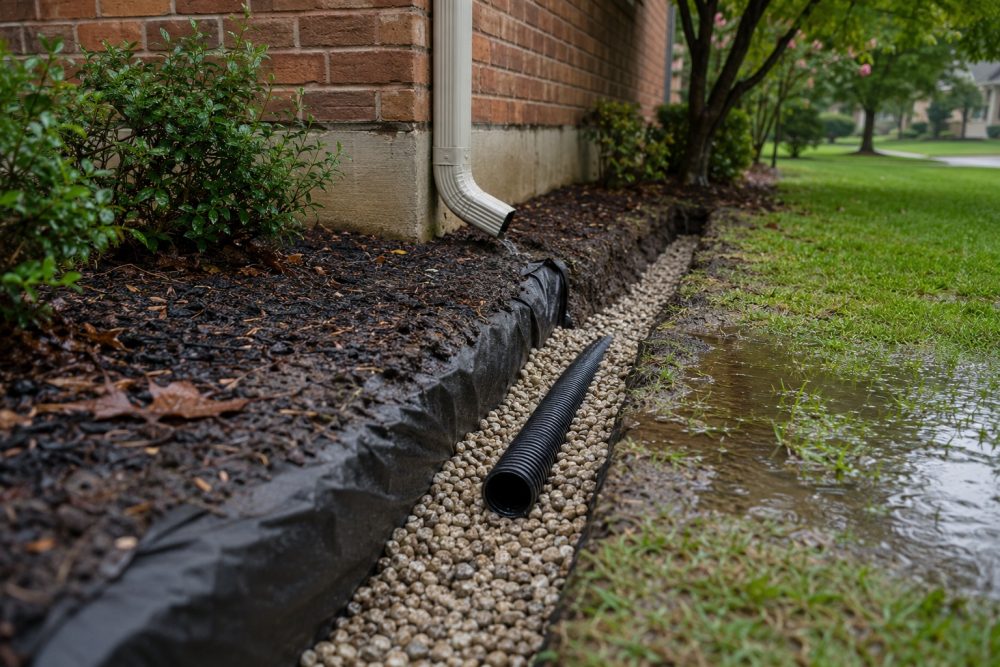
How French Drain Systems Protect Homes From Water Damage
A French drain protects a home by giving unwanted water a controlled path away from vulnerable areas. The system typically consists of a gravel-filled trench containing perforated drainage pipe. Water enters through the gravel and pipe, then travels toward an appropriate outlet instead of collecting beside the foundation.
The University of Minnesota Extension explains that French drains can intercept surface water and some groundwater and drain it away from the area being protected.
For homeowners, that can help address several common drainage problems:
- Standing water near the foundation
- Soggy or muddy areas after rainfall
- Runoff flowing toward the house
- Oversaturated soil near patios and landscaping
- Water collecting in low areas of the yard
- Persistent moisture near crawl spaces or other vulnerable areas
A French drain does not eliminate rainfall or guarantee that a property can never flood. Instead, it helps manage water before it accumulates where it can cause damage.
How Does a French Drain Keep Water Away From a House?
A French drain intercepts water and redirects it downhill or toward a suitable discharge location before that water can pool beside the home.
Water naturally follows gravity and the path of least resistance. If a yard slopes toward the house or contains depressions, runoff may collect near the foundation. Soil that becomes saturated can also hold moisture against the home long after a storm passes.
A correctly installed French drain creates a more efficient route for that water. The gravel allows moisture to move into the trench, while the perforated pipe collects and carries it away.
This is why placement matters. Installing a French drain where water is not actually traveling may do little to solve the underlying problem. A drainage professional should evaluate the grade, problem areas, soil, and available outlet before determining where the system belongs.
Why Are French Drains Useful in Dallas, Houston, and Oklahoma?
Heavy rainfall and localized drainage problems make effective stormwater management particularly important throughout these service areas.
Houston offers a clear example. The City of Houston explains that rainfall exceeding the capacity of drainage infrastructure can cause backups and localized flooding. The city continues to invest heavily in drainage and flood mitigation, including increased funding for street and drainage infrastructure.
Houston’s experience with Hurricane Harvey also illustrates why homeowners should not assume that being outside a mapped high-risk area eliminates drainage concerns. A City of Houston assessment found that 59% of Harvey-related damage occurred outside the 500-year floodplain. Sustained heavy rainfall and inadequate drainage contributed to widespread ponding.
Oklahoma properties can face similar problems during intense thunderstorms. In July 2026, for example, the National Weather Service issued a flash flood warning in western Oklahoma after 1.5 to 3 inches of rain had already fallen, noting risks to urban areas and other low-lying or poorly drained locations.
Dallas-area homeowners can also experience rapid runoff during North Texas thunderstorms, particularly on properties with compacted soil, low spots, or grading that directs water toward the house.
The takeaway is simple: French drains are most valuable when a property repeatedly sends or holds water near the home after heavy rainfall.
What Are the Signs Your Home May Need a French Drain?
Recurring water accumulation is one of the strongest signs that a drainage evaluation is worthwhile. One puddle after an unusually severe storm does not necessarily mean you need a French drain, but repeated drainage problems should not be ignored.
Watch for signs such as:
- Water pooling beside the foundation. Standing water against the house indicates runoff is not moving away efficiently.
- A yard that stays soggy for days. Persistent saturation can indicate poor drainage or a low area collecting runoff.
- Water flowing toward the house during storms. The yard’s grade may be directing runoff in the wrong direction.
- Erosion or washed-out landscaping. Visible soil movement can reveal the path water takes during heavy rain.
- Moisture appearing in low interior areas. Water intrusion may have multiple causes, so the source should be identified before choosing a drainage solution.
A useful homeowner tip is to safely observe the property during moderate rainfall. Look at where water originates, which direction it travels, where it slows down, and where it ultimately collects. Those patterns provide valuable clues when designing a drainage solution.
Will a French Drain Completely Prevent My House From Flooding?
No drainage system can guarantee that a home will never flood, especially during extreme rainfall, regional flooding, overflowing waterways, or storms that exceed the capacity of local drainage infrastructure.
A French drain is designed primarily to address property-level drainage and groundwater problems. It can be highly effective when flooding risk comes from water accumulating in the yard or near the foundation, but it is not a substitute for municipal flood-control infrastructure or other flood-protection measures.
In some yards, the best solution may combine a French drain with:
- Proper lawn grading
- Surface drains or catch basins
- Downspout extensions
- Swales
- Erosion-control measures
- Other drainage improvements
Accurate Lawn Leveling evaluates the broader drainage pattern instead of assuming every wet yard needs the exact same system. The goal is to move water safely and efficiently while addressing the actual source of the problem.
Frequently Asked Questions About French Drains and Flood Prevention
Where should a French drain be installed around a house?
A French drain should generally be positioned where it can intercept unwanted water before that water reaches the foundation or another vulnerable area. The exact location depends on the property’s slope, soil, runoff pattern, and safe discharge options.
How deep does a French drain need to be?
There is no single correct depth for every property. The appropriate depth depends on whether the system needs to capture primarily surface runoff, subsurface water, or both, as well as site conditions and the required pipe slope.
Can a French drain handle heavy rain?
A properly sized and installed French drain can manage significant amounts of property-level runoff, but no residential drainage system has unlimited capacity. Extreme storms may produce more water than a system can manage, making proper sizing, grading, and discharge especially important.
Is a French drain better than simply leveling the yard?
They solve different drainage problems and can sometimes work together. Lawn leveling or grading helps control how surface water moves, while a French drain can capture and transport water through a subsurface drainage system. A professional assessment can determine which approach, or combination, is appropriate.
Protect Your Home Before the Next Heavy Rain
Water collecting around a house should not be treated as a normal part of every storm. Repeated standing water, saturated soil, erosion, and runoff flowing toward the foundation can signal a drainage problem that may worsen over time.
For homeowners in Dallas, Houston, and Oklahoma, a professionally planned French drain can create a controlled path for excess water and help reduce the risk of property-level flooding and water damage.
Ready to improve your drainage and protect your property? Contact Accurate Lawn Leveling to discuss a French drain solution for your home.