
How Do We Level a Sloped Lawn?
A sloped lawn is leveled by first evaluating its existing grade and drainage, then strategically reshaping low and high areas with appropriate soil materials. For moderate slopes, lawn leveling and top dressing may create a smoother, more usable surface. Steeper grades may require more extensive grading, drainage improvements, or retaining walls to safely manage soil and water.
Accurate Lawn Leveling has been helping homeowners and businesses throughout Dallas, Houston, and Oklahoma City improve uneven lawns for more than 30 years. Our approach is not simply to make a yard look flatter. We consider how water moves across the property, where soil has settled, the condition of the existing turf, and how the finished lawn needs to function. Our team uses quality materials and careful, detail-oriented techniques to improve lawn smoothness while protecting drainage and turf health. Whether a property has minor rolling areas or a more challenging grade, the goal is a lawn that looks better, performs better, and remains practical to maintain.
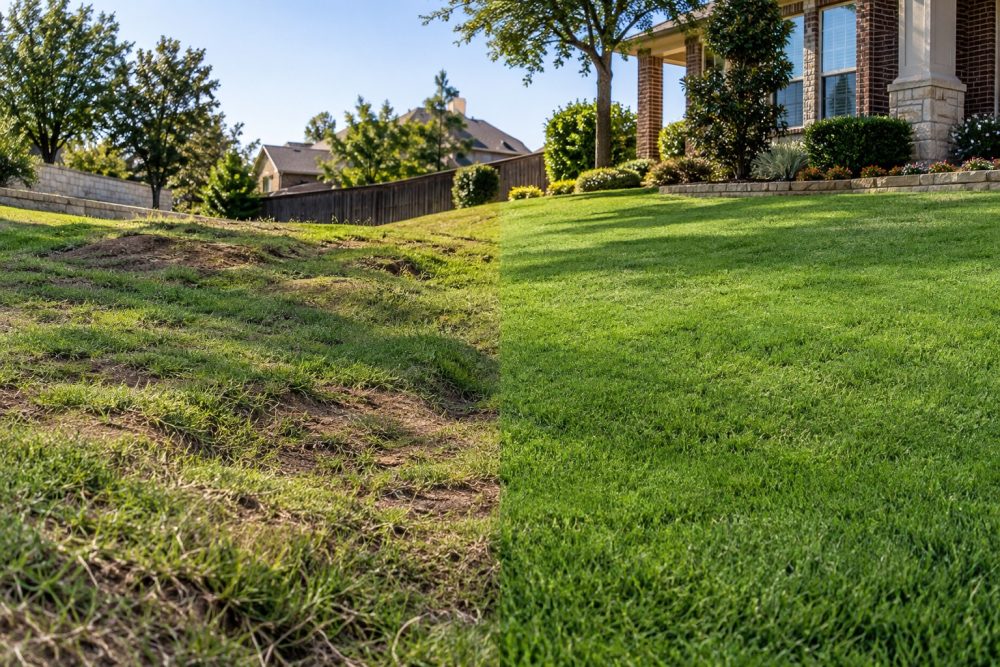
Professional Sloped Lawn Leveling and Grading
Leveling a sloped lawn does not necessarily mean making the entire property perfectly flat. In fact, some slope is important because water needs a safe route away from buildings and across the landscape.
Texas A&M AgriLife Extension recommends grading turf so that it drains away from houses, walks, and driveways. Its turf establishment guidance states that a fall of approximately 6 inches over 40 to 50 feet can provide adequate drainage in appropriate situations. Oklahoma State University similarly recommends at least a 1 percent slope away from buildings when preparing a lawn.
The objective is therefore controlled grading, not simply flattening the yard.
How Do We Determine How Much Leveling a Sloped Yard Needs?
The first step is identifying where the existing slope helps drainage and where it creates problems. A gradual slope that moves water safely away from a house may need to remain, while abrupt changes in elevation, depressions, erosion channels, and uneven turf may need correction.
We evaluate factors such as:
- High and low areas in the lawn
- Direction of surface runoff
- Standing water after rain or irrigation
- Soil settlement and compaction
- Existing grass condition
- Proximity to the home and other structures
- Drainage paths and discharge areas
- Severity of the overall grade
This assessment is particularly important because correcting one area should not create a drainage problem somewhere else. Oklahoma State University notes that effective landscape drainage should address excess water without creating a larger problem for downhill neighbors.
What Is the Process for Leveling a Sloped Lawn?
For a moderately uneven or sloped lawn, we can often improve the surface by carefully adding and distributing leveling material while maintaining proper drainage. Accurate Lawn Leveling uses customized soil, compost, and sand mixtures to fill low areas and create a smoother turf surface.
A typical project may involve these steps:
- Evaluate the grade. We identify uneven areas and determine how water currently moves through the property.
- Develop the leveling plan. We determine which areas should be built up and where the existing slope needs to remain for drainage.
- Apply the appropriate material. A carefully selected soil blend is added to low or uneven areas.
- Hand-level the lawn. Material is distributed to create a smoother transition between elevations.
- Address deeper areas as needed. Grass seed or plugs may be incorporated where significant depressions require additional material.
- Check the finished grade. The lawn should remain capable of moving water in the intended direction rather than creating new pockets where water collects.
For ordinary top dressing, Accurate Lawn Leveling generally applies approximately 1/4 to 1/2 inch of material so existing grass can continue growing through it. Deeper depressions and larger slopes require a different approach rather than simply covering the lawn with a thick layer of material.
Can Top Dressing Fix Every Sloped Lawn?
No. Top dressing is best for smoothing relatively moderate irregularities, not eliminating a severe grade. A steep slope can involve larger issues with runoff, erosion, soil stability, and usability.
Oklahoma State University explains that runoff velocity increases as land becomes steeper, increasing erosion and sediment problems when the surface is not adequately protected.
Depending on the property, a severely sloped yard may require:
- More extensive grading
- Additional topsoil
- Drainage improvements
- French drains or surface drainage
- Retaining walls
- A combination of grading and drainage solutions
Accurate Lawn Leveling also installs retaining walls for properties with steep grades. A properly designed retaining wall can stabilize soil, reduce erosion, and create more manageable changes in elevation.
This is why an on-site evaluation matters. The correct solution depends on the degree of the slope and what is causing the problem.
Why Is Drainage So Important When Leveling a Yard?
Drainage determines whether a newly leveled lawn will continue performing well after the project is complete. Making a surface visually flat without accounting for runoff can leave water trapped near the house or create new areas of standing water.
Texas A&M AgriLife recommends eliminating pockets and depressions that collect water while maintaining a grade that drains away from structures. The organization also notes that subsurface drainage may be necessary on poorly drained sites.
That guidance is especially relevant for properties in Dallas, Houston, and Oklahoma. Heavy rainfall can expose grading problems quickly, while compacted or clay-rich soils can slow infiltration and increase runoff. Texas A&M specifically notes that compacted or clay soils can contribute to runoff problems, and Oklahoma State identifies soil texture, grading, slope, and hydrology as major factors affecting landscape drainage.
A properly leveled lawn should therefore be smooth enough to use and maintain, but graded enough to move water where it belongs.
What Are the Benefits of Correcting a Sloped, Uneven Lawn?
Professional lawn leveling can improve both the appearance and everyday function of a property. Correcting troublesome low spots and abrupt changes in grade creates a more consistent lawn surface while supporting better turf management.
Potential benefits include:
- Smoother mowing and a more consistent cut
- Fewer scalped areas caused by mower blades hitting high spots
- Reduced standing water in depressions
- Better conditions for healthy turf growth
- Fewer hidden dips and bumps under the grass
- More comfortable space for children, pets, entertaining, and recreation
- Improved overall appearance and curb appeal
Accurate Lawn Leveling’s top-dressing process can also improve soil composition and help alleviate compaction, supporting stronger turf growth over time.
Sloped Lawn Leveling FAQs
Should a lawn be completely flat?
No. A lawn generally needs some grade so rain and irrigation water can drain safely. The goal of lawn leveling is a smooth, functional surface with controlled drainage, not a perfectly horizontal yard.
Can you level a lawn without removing all the grass?
Yes, many moderately uneven lawns can be improved through top dressing without removing the existing turf. Accurate Lawn Leveling typically applies a thin soil, compost, and sand mixture that allows established grass to grow through the material.
How do you fix a very steep backyard?
A very steep backyard may need grading, drainage improvements, retaining walls, or a combination of solutions rather than standard top dressing alone. Steeper slopes increase runoff velocity and erosion risk, so the property should be evaluated before choosing a solution.
Can leveling a sloped lawn help with standing water?
Yes, if improper grading or depressions are causing the standing water. However, some properties also require a drainage system because grading alone cannot adequately move excess water away.
Ready to Improve Your Sloped Lawn?
A sloped or uneven yard does not always need to be completely rebuilt. The right solution starts with understanding the grade, soil, turf, and drainage conditions, then choosing a leveling approach that creates a smoother lawn without interfering with proper water movement.
Ready for a smoother, more functional lawn in Dallas, Houston, or Oklahoma? Contact Accurate Lawn Leveling to schedule an estimate and find out which lawn leveling solution is right for your property.