
Why Is Water Pooling Around My House After Construction, and How Do I Fix the Grading?
Water pooling around your house after construction is often caused by improper or settled grading that allows rainwater to collect near the foundation instead of flowing away. Fixing the problem typically requires reshaping and compacting the soil to create positive drainage, then adding swales, surface drains, or French drains when grading alone cannot provide a safe path for runoff.
At Accurate Lawn Leveling, we help homeowners in Dallas, Houston, and Oklahoma correct drainage problems that can appear after new construction, additions, patios, landscaping projects, or other work that changes the elevation of a property. A yard can look finished while still having subtle low spots or slopes that send water toward the house. Our approach focuses on identifying where water comes from, where it collects, and where it can safely go. The goal is not simply to eliminate a puddle. It is to establish a reliable drainage path that protects the lawn, landscaping, and home while creating a more usable outdoor space.
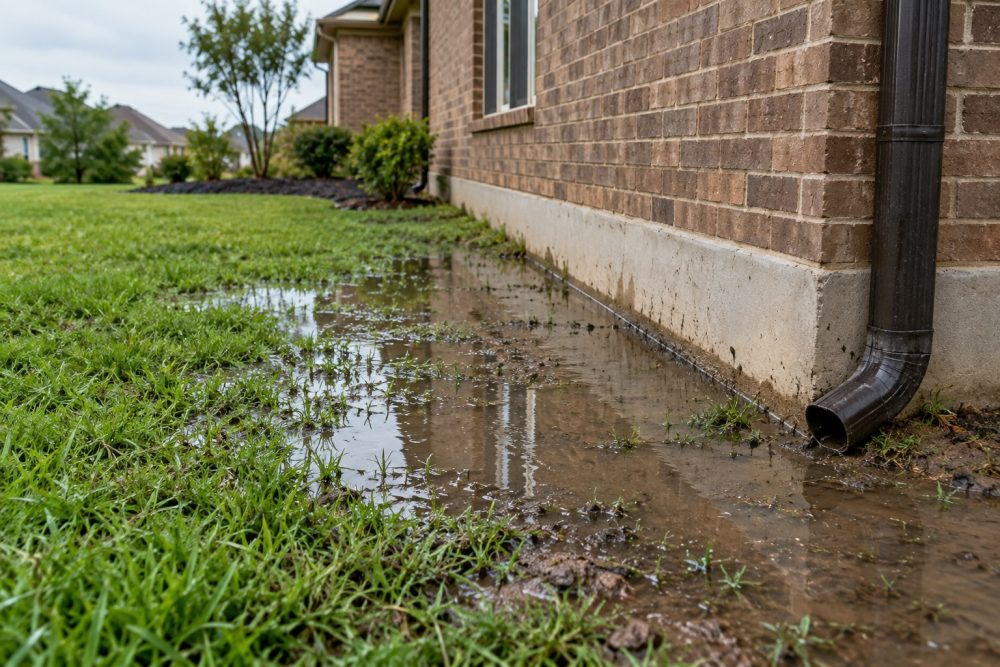
How Poor Yard Grading Causes Foundation Drainage Problems
Proper grading uses the shape and elevation of the ground to move surface water away from a home. When the grade slopes toward the foundation, or when construction leaves depressions beside the house, rainwater naturally follows those low points.
The U.S. Environmental Protection Agency recommends planning the surrounding grade so water moves away from a building. EPA moisture-control guidance specifies a 5 percent slope, equivalent to about 6 inches of fall over 10 feet, as a general design target for finish grade around foundations, subject to local requirements.
That means even relatively small elevation errors can matter.
Why Does Water Start Pooling After Construction?
Water often begins pooling after construction because excavation, backfilling, heavy equipment, new hardscaping, or final landscaping changes how water moves across the property.
Soil placed around a newly constructed or repaired foundation can also settle. Oklahoma State University notes that settling and landscape activities can reduce the outward slope around a home, eventually allowing water to pond beside the structure.
Common post-construction causes include:
- Backfilled soil settling around the foundation
- Low spots created during final grading
- Soil compacted by construction equipment
- New patios, sidewalks, or driveways redirecting runoff
- Downspouts releasing water into poorly drained areas
- Neighboring or upslope development sending additional runoff toward the property
- Landscaping or soil additions disrupting an existing swale
A drainage issue that appears after construction does not automatically mean there is a foundation defect. It does mean the source of the water and the surrounding elevations should be evaluated.
Can Bad Grading Cause Water to Leak Into a House?
Yes. Poor grading can increase the risk of moisture intrusion by keeping rainwater against or near the foundation instead of directing it away.
EPA guidance specifically identifies managing water outside foundation walls as a moisture-control strategy and recommends grading the ground away from the home.
Warning signs can include standing water along the foundation, consistently soggy soil, erosion, water stains, musty odors, crawl-space moisture, or water appearing indoors after rain.
Not every leak is caused by grading. Plumbing failures, roofing problems, damaged gutters, foundation penetrations, groundwater, and other issues can produce similar symptoms. If water is entering the home, identifying the actual source is essential before choosing a drainage solution.
How Much Slope Should a Yard Have Away From the Foundation?
The exact requirement depends on the property and local code, but the ground immediately around a home should provide positive drainage away from the structure.
EPA moisture-control guidance uses approximately 6 inches of fall over the first 10 feet as a benchmark. Houston’s current minimum construction standards similarly call for a positive drainage path away from the foundation and reference a minimum 6-inch fall over the first 10 feet in residential site drainage details.
Space limitations can make that slope impossible on some properties. In narrow side yards or lots where another structure or property line blocks the necessary fall, a properly designed swale or drainage system may be needed instead.
This is why simply adding a few bags of topsoil beside the house is not always enough. The entire drainage path has to work.
What Does It Take to Fix Bad Grading Around a House?
Correcting bad grading usually involves determining existing elevations, filling low areas, reshaping the soil, compacting it appropriately, and establishing a continuous path that carries runoff away from the home.
Depending on the site, the solution may include:
- Identify the drainage problem. Determine where runoff originates and where water currently stops or reverses direction.
- Establish the correct elevations. The yard needs sufficient fall to move water away without creating drainage problems for neighboring properties.
- Regrade problem areas. Soil can be added, removed, or redistributed to eliminate depressions and reverse negative slopes.
- Create a drainage path. Swales or carefully shaped surface contours can guide runoff toward an appropriate discharge point.
- Add drainage infrastructure when necessary. Surface drains, French drains, or connected downspout drainage may be appropriate when grading alone cannot solve the problem.
- Restore the lawn. Once elevations and drainage are corrected, affected turf and landscaping can be repaired.
Oklahoma State University identifies grading, slope, soil properties, and runoff as interconnected causes of landscape drainage problems and notes that solutions can include grading, surface drains, French drains, culverts, and other drainage methods.
Why Drainage Problems Matter in Dallas, Houston, and Oklahoma
Local rainfall and soil conditions make proper grading especially important throughout Accurate Lawn Leveling’s service areas.
In the Dallas-Fort Worth area, National Weather Service climate normals show about 37 inches of precipitation annually. In Houston, the 1991-2020 normal at Bush Intercontinental Airport is approximately 51.84 inches per year, meaning a poorly graded property can be exposed to substantial amounts of runoff.
Oklahoma presents its own challenges. Oklahoma State University explains that drainage varies considerably with soil type and location, and many Oklahoma soils have characteristics that can contribute to slow drainage. The agency also notes that impervious surfaces such as roofs, streets, sidewalks, and driveways increase runoff in developed neighborhoods.
Whether you own a newer home in North Texas, a Houston-area property dealing with frequent heavy rainfall, or an Oklahoma home with clay-heavy soil, the principle remains the same: water needs a deliberate path away from the house.
Frequently Asked Questions About Water Pooling After Construction
Is standing water next to my foundation an emergency?
Occasional water during an intense storm does not necessarily mean the foundation is failing, but repeated ponding beside the house should not be ignored. Persistent water indicates that runoff is not draining effectively and warrants an evaluation.
Will adding topsoil fix water pooling around my house?
It can help when a small, shallow depression is the only problem, but adding soil without checking elevations may simply move the puddle elsewhere. The finished surface needs a continuous drainage path away from the foundation.
Do I need a French drain or just regrading?
If the yard has enough elevation to move surface runoff away naturally, regrading may be the better solution. A French drain, surface drain, or other drainage system may be necessary when site constraints, soil conditions, neighboring elevations, or narrow side yards prevent adequate surface drainage.
Why did my yard drain properly when the house was new but start pooling later?
Soil around foundations and disturbed construction areas can settle over time, reducing the original slope. Landscaping changes, erosion, new patios, neighboring construction, and changes to downspouts can also alter how runoff moves across the property.
Fix the Cause of Standing Water, Not Just the Puddle
Standing water after construction is often a sign that the yard’s elevations and drainage paths are no longer working as intended. Correcting the grade can help move rainwater away from your home, protect your lawn and landscaping, and reduce prolonged moisture around the foundation.
Accurate Lawn Leveling provides professional lawn leveling, grading, and drainage solutions for homeowners throughout Dallas, Houston, and Oklahoma. We evaluate the property as a complete drainage system so the solution addresses where the water comes from, where it needs to go, and what is preventing it from getting there.
Ready to stop water from pooling around your home? Contact Accurate Lawn Leveling to schedule an evaluation and find the right grading or drainage solution for your property.